

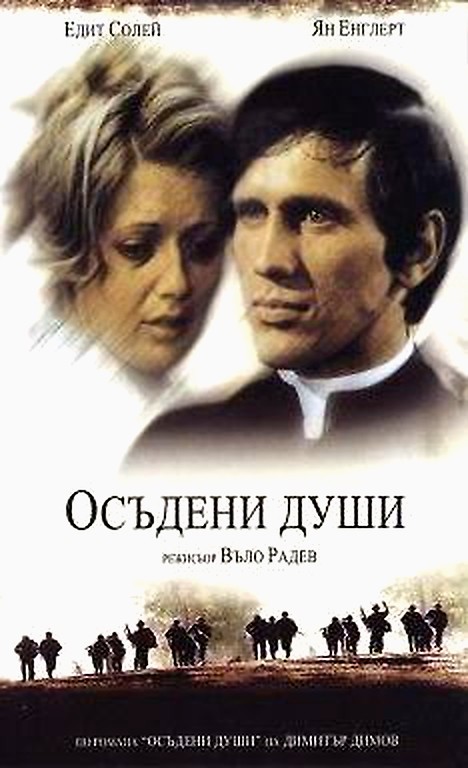
Osydeni dushi
Did You Know?
- On the first day of filming, director Vulo Radev brought expensive Spanish cognac and treated the entire crew according to a Spanish ritual, hoping to immerse them in the atmosphere of Spain.
- After the film was screened in Spain, Spanish critics reportedly debated which part of the country it had been filmed in, even though the production was shot in Bulgaria, Prague and Dubrovnik.
- Director Vulo Radev paid exceptional attention to the accuracy of every visual detail in order to create an authentic Spanish setting without filming in Spain.
- Radev sent assistants to Madrid, where they purchased caps and uniform buttons associated with different sides in the Spanish Civil War. Exact replicas of the uniforms were then produced in Bulgaria.
- For scenes showing retreating Republican forces, the production created a field of thick mud near the village of Gortalovo in the Pleven region.
- For a scene in which Father Heredia helps the injured Carlito, the crew made a facial cast from a badly beaten patient at Pirogov Hospital and applied it to the actor's face to achieve greater realism.
- During the scene in which Luisa's hair is cut, the young actress initially refused to be shorn. Radev let her step away, cut his own hair first and persuaded her to return to the chair, allowing the camera to capture her genuine tears.
- Photographer Lyudmil Hristov, who documented the production, later recalled that working with Vulo Radev and the actors gave him valuable lessons that shaped his future career in cinema.
- Hristov's photographs preserve the energy and scale of the production, including moments from the filming of large explosions.
- Hristov recalled speaking frequently with Jan Englert during filming and receiving valuable professional advice from the Polish actor.
- Before its official premiere, the film received the gold medal for a feature film at the Sixth International Festival of Red Cross and Health Films in Varna.
- During the first week after its November 1975 premiere, the film was seen by more than 175,000 viewers in Sofia cinemas alone.
- The film was shot across several countries, including Bulgaria, Czechoslovakia, Hungary and Yugoslavia.
- Condemned Souls is often described as Vulo Radev's favorite among the films he directed.
- Filip Andreev considered the decision to cast foreign actors Edith Szalay and Jan Englert in the leading roles entirely appropriate, believing that it reinforced the story's sense of distance and authenticity.
Why Should I Watch the Movie?
"Doomed Souls" is far more than a historical drama. It is a powerful story of love, faith, and moral conviction tested in the chaos of war.
Set during the Spanish Civil War, the film follows characters forced to choose between love, duty, and deeply held beliefs. Rather than offering simple answers, it explores timeless questions about sacrifice, forgiveness, and the cost of remaining true to one's principles.
With outstanding performances, unforgettable atmosphere, and remarkable emotional depth, Doomed Souls remains one of the grand achievements of Bulgarian cinema—a film that reminds us that even in humanity's darkest moments, love and dignity are often put to the greatest test.
Creators
| Director |
Vylo Radev
Vulo Radev (Bulgarian: Въло Радев) (1 January 1923 - 28 March 200... [more] |
| Writer | Dimityr Dimov |
| Writer |
Vylo Radev
Vulo Radev (Bulgarian: Въло Радев) (1 January 1923 - 28 March 200... [more] |
Credits
| # | Name / Biography | Role | |
|---|---|---|---|
| 1. |

|
Qn Englert | Otec Erediq |
| 2. |
|
Edit Salai | Fani Horn |
| 3. |

|
Rusi Chanev | Jak Miurie |
| 4. |
|
Mariqna Dimitrova
Mariana Pencheva Dimitrova was born in on May 28th, 1954 in the v... [more] |
Karmen |
| 5. |
|
Vylcho Kamarashev | Otec Olivares |
| 6. |
|
Silviq Rangelova
Silviq Stankova Rangelova-Sungarska was born on August 24th, 1948... [more] |